
BioChar
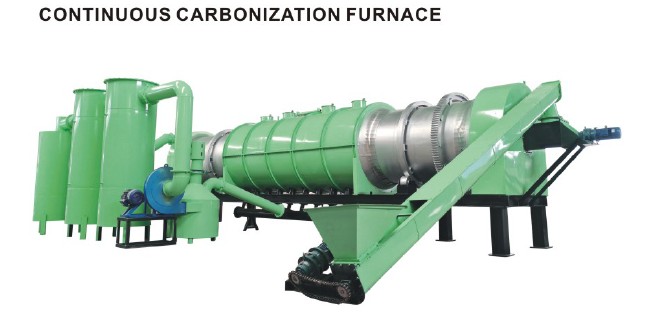

The carbonization process is actually the dry distillation process of the materials under high temperature conditions. In this process, the material is gradually heated within a certain low temperature range and under the condition of isolating air. The low molecular weight substances in the material first volatilize, and then a series of complex physical and chemical changes will occur in the material during the entire carbonization process. Physical changes are mainly two types of reactions, thermal decomposition and thermal polycondensation. Biomass carbonization refers to the process in which biomass raw materials are heated in an anaerobic or hypoxic environment to cause the internal decomposition of molecu- les to form biochar, and non-condensable gas products (combustible gas)
Description 1
This carbonization furnace converts small-size materials into high-quality charcoal by heating biomass under low-oxygen conditions. The material undergoes high-temperature pyrolysis, impurities are removed, and the carbon portion is obtained.
It is suitable for materials under 20 mm, such as sawdust, palm shell, rice husk, peanut shell, biomass particles, bamboo powder, and similar fine materials. Raw materials enter the carbonizing drum via a screw conveyor, move forward under high temperature, and gradually carbonize. Finished charcoal is discharged through a cooling conveyor with a water-circulation system for safe, continuous cooling.
The equipment includes a complete smoke and gas purification system. Combustible gas generated during carbonization is purified and returned to the furnace as a heat source, significantly reducing energy consumption.
This fully automatic machine is controlled via a PLC control cabinet, requiring no operators during production, ensuring stable, efficient, and environmentally friendly operation.
Description 2
1) V'M Biocharcoal
It's widely used as fuel for grilling and roasting. It also supports agriculture and forestry carbon sequestration, reduces emissions, and improves soil fertility. Additionally, it can be processed into activated carbon, which is widely used in foundry, chemical industry, and other fields.
2) MM Gas
This gas is recycled to heat the carbonization furnace, making the system more efficient and significantly reducing fuel costs.
Description 3
1) Material Carbonation Parameters
The carbonization temperature of the material is also its reaction temperature. Biomass is generally heated to 380–550°C. The discharge temperature is below 30°C (if there is a buffer bin, it can be ignored since the process is closed and not exposed to oxygen). The furnace temperature ranges from 450–750°C. The rotating speed is normally 1–9, with frequency conversion control based on actual operation.
2) Exhaust Emissions
The mixed gas produced during the reaction is burned in the furnace a second time at 500–800°C. This serves two purposes:
- Provides the heat source for the furnace. The use of fuel in the main furnace can be adjusted according to actual gas production to save energy. In some cases, only combustible gas is sufficient to provide the heat source.
- Burns the mixed gas at high temperature, eliminating harmful gases and reducing emission pressure.
Description 4
3) Temperature Monitoring and Motor
The equipment is equipped with 4–6 thermocouples, providing 4–6 temperature detection points (installation locations: main furnace, auxiliary furnace, biogas outlet, waste smoke inlet, waste smoke outlet, biochar outlet). All thermocouples are connected to the PLC, allowing operators to monitor temperatures and adjust fan speed to ensure biochar quality. Note: Reaction temperature and time affect biochar quality.
4) Reaction Time
Using wood chips and rice husks as examples, the carbonization process from feeding to discharging lasts 15–25 minutes. Carbonization time depends on particle size, density, moisture content, and the desired properties of the finished charcoal.
5) Carbon Yield
For materials such as wood chips, rice husks, and crushed coconut shells with moisture content below 10%, each ton of raw material yields approximately 280–310 kg of finished charcoal, roughly maintaining a 3:1 ratio.
Description 5
6) Repair and Maintenance
Due to variations in materials and supporting processes, our installers provide on-site training for the owner's personnel on proper operation and daily precautions after installation and commissioning. An operation manual is also provided, detailing maintenance procedures and guidelines for keeping the equipment in optimal condition.
Description 6
Hoisting Carbonizing Furnace
The lifting carbonization furnace achieves a carbonization rate of up to 99%, operating smokelessly and pollution-free. Raw materials are carbonized into carbon rods within 6–10 hours. The inner tank and combustion chamber are independent, allowing continuous operation and production 2–3 times per 24 hours. The exhaust pipe collects gas, which is recovered, purified, and recycled for heating in the furnace. The gas recovery rate is up to 90%, saving approximately 75% of energy. The furnace has good sealing, a simple overall structure, is easy to operate, and ensures safe operation.
Description 7
Horizontal Carbonizing Furnace
Carbonization Stage
1) Carbonizing Furnace Drying Stage
From ignition until the furnace temperature rises to 160°C, the water contained in the material mainly evaporates due to external heat and heat generated by combustion. During this stage, the chemical composition of the material remains largely unchanged.
Hoisting Charcoal Furnace
The hoisting carbonization furnace is suitable for large materials such as wood, bamboo, coconut shell, and other biomass. It features an inner pot that allows cooling outside the furnace before starting the next batch, making carbonization more efficient. The heat source can be waste wood or a burner. The price includes 2 inner tanks and a smoke purification system.
| Types | Inner Tank | Dimensions | Capacity | Gross Weight | Price (EXW) | Tank Price |
|---|---|---|---|---|---|---|
| Φ 1.6×2m | Φ 1.2×1m | 1.5×1.5×2m | 1000 kg/day | 3000 kg | USD 3000 | USD 650 |
| Φ 1.9×2.2m | Φ 1.5×1.5m | 2×2×2.2m | 2000 kg/day | 3500 kg | USD 3800 | USD 800 |
Horizontal Carbonizing Furnace
This furnace is used to make charcoal from wood branches, bamboo, coconut shell, wood briquettes, and similar materials. It is designed with a smoke and gas purification system, ensuring a pollution-free workshop during operation.
| Types | Dimensions (diameter*length) | Capacity | Material Thickness | Machine Size | Weight | Price (EXW) |
|---|---|---|---|---|---|---|
| KT-50 | Φ0.5*1m | 50 kg/batch | 6 mm | 1.1×0.7×1m | 180 kg | USD 350 |
| KT-100 | Φ0.8*0.75m | 100 kg/batch | 6 mm | 1.1×1×1.4m | 200 kg | USD 550 |
| KT-200 | Φ0.8*1.5m | 200 kg/batch | 6 mm | 1.8×1×1.4m | 400 kg | USD 700 |
| KT-250 | Φ1*1.5m | 250 kg/batch | 6 mm | 1.8×1.2×1.6m | 650 kg | USD 900 |
| KT-300 | Φ1.2*1.5m | 300 kg/batch | 8 mm | 1.8×1.2×1.7m | 800 kg | USD 1100 |
| KT-500 | Φ1.25*1.5m | 500 kg/batch | 8 mm | 1.8×1.2×1.7m | 1000 kg | USD 1400 |
| KT-800 | Φ1.3*1.8m | 800 kg/batch | 8 mm | 2.3×1.3×1.8m | 1200 kg | USD 1900 |
| KT-1000 | Φ1.4*2m | 1000 kg/batch | 8 mm | 2.5×1.4×2m | 1500 kg | USD 2300 |
| KT-1500 | Φ1.5*3m | 1500 kg/batch | 8 mm | 3.3×1.7×2.1m | 1800 kg | USD 2700 |
| KT-1540 | Φ1.54*3m | 1500 kg/batch | 12 mm | 3.3×1.7×2.1m | 2100 kg | USD 3200 |
| KT-1545 | Φ1.54*3.5m | 2000 kg/batch | 12 mm | 3.8×1.7×2.1m | 2700 kg | USD 3400 |
| KT-1845 | Φ1.8*3.5m | 3000 kg/batch | 12 mm | 4.3×2×2.2m | 3200 kg | USD 4300 |
| KT-2035 | Φ2*3.5m | 3200 kg/batch | 12 mm | 4.3×2.3×2.5m | 4000 kg | USD 4900 |
| KT-2045 | Φ2*4.5m | 3700 kg/batch | 12 mm | 5.3×2.3×2.5m | 4500 kg | USD 5300 |
| KT-2050 | Φ2*5m | 4000 kg/batch | 12 mm | 5.7×2.3×2.5m | 4800 kg | USD 5800 |
| KT-3050 | Φ2.3*5m | 4700 kg/batch | 12 mm | 6×2.6×2.8m | 6000 kg | USD 7200 |
| KT-4000 | Φ2.8*7m | 5800 kg/batch | 12 mm | 8.2×3.3×3.2m | 8400 kg | USD 9500 |
| Detail | A-Mode | B-Mode | C-Mode | D-Mode |
|---|---|---|---|---|
| Type | Continuous Carbonization Stove | |||
| Voltage | 380V / Customized | |||
| Motor Power (kW) | 3+2.2+4+1.5+3+3 | 3+3+4+1.5+3+3 | 3+4+4+2.2+3+3 | 3+5.5+7.5+3+3+3 |
| Capacity (kg/h) | 200-300 | 500-600 | 700-900 | 1000-1500 |
| Host Machine Weight (kg) | 1500 | 2000 | 3500 | 6000 |
| Total Weight (kg) | 5000 | 6000 | 8600 | 12000 |
| Material Size | ≤20mm | |||
| Working Time | 24h | |||
| Host Machine Size | 0.8×10m | 1.0×10m | 1.2×10m | 1.5×10m |
| Chamber Temperature | 350–500℃ | |||
| Carbonizing Temperature | 500–700℃ | |||
| Effective Volume | 4m³ | 5m³ | 7m³ | 10m³ |
| Item | Wheat Straw | Chinese Fir | Eucalyptus | Italian Hardwood | Acacia | Red Ironwood | Red Mahogany |
|---|---|---|---|---|---|---|---|
| Total Moisture | 1.56% | 3.40% | 1.20% | 0.73% | 3.41% | 3.83% | 2.66% |
| Moisture | 0.10% | / | / | 0.35% | 1.90% | 1.58% | 1.22% |
| Ash | 19.40% | 2.19% | 4.10% | 8.11% | 5.33% | 6.20% | 6.55% |
| Volatile Matter | 12.90% | 13.63% | 9.30% | 4.86% | 20.75% | 23.11% | 14.25% |
| Fixed Carbon | 67.60% | 80.78% | 85.40% | 86.86% | 72.02% | 69.11% | 77.98% |
| Gross Calorific Value | 5562 Kcal/Kg | / | / | 7448 Kcal/Kg | 7075 Kcal/Kg | 6793 Kcal/Kg | 7300 Kcal/Kg |
| Net Calorific Value | 5467 Kcal/Kg | 7480 Kcal/Kg | 7688 Kcal/Kg | 7256 Kcal/Kg | 6773 Kcal/Kg | 6437 Kcal/Kg | 7014 Kcal/Kg |
| Name | Moisture | Reaction Temperature | Reaction Time | Biochar Yield Rate |
|---|---|---|---|---|
| Pericarpium | 10% | 510℃–632℃ | 22min | 23.80% |
| Shabili Wood Grains | 13% | 598℃–645℃ | 17min | 28.80% |
| Peanut Shell | 13%–18% | 540℃–580℃ | 15min | 21.20% |
| Eucalyptus Sawdust | 15% | 555℃–598℃ | 20min | 16.05% |
| Eucalyptus Wood Block | 15% | 508℃–674℃ | 15min | 20.21% |
| Apple Tree Wood Block | 12% | 496℃–583℃ | 18min | 33.41% |
| Wheat Straw | 10% | 463℃–538℃ | 17min | 29.30% |
| Bolivian Sawdust | 10% | 522℃–592℃ | 17min | 21.54% |
| Eucalyptus Chips | 15% | 490℃–574℃ | 18min | 21.38% |
| Coconut Shell | 9% | 542℃–620℃ | 18min | 29.54% |
| Wood Particle | 8% | 562℃–616℃ | 16min | 33.14% |
| Clean Wood Sheet | 12% | 526℃–608℃ | 14min | 23.00% |
| Wood Shavings | 8% | 513℃–553℃ | 14min | 23.00% |